ABOUT RUBBER GASKETS


The Pasta Kitty on Grand Street
On Sunday afternoon I walked all the way to Little Italy to the E. Rossi and Company store at number 193 Grand Street with my little old stovetop macchinetta in my bag, to buy a new rubber gasket for it. But when I got there the shop was dark and the “Closed” sign was in the window.  It’s a big messy old shop that sells Italian tchotchkes, and a day or two earlier I saw that the doors were open and outside on the sidewalk in front, an old geezer was parked on a chair. I asked him if he had any gaskets. He got up and went behind the counter, where he unearthed a cardboard box full of gaskets of all sizes and thicknesses. He said, “What kind is it?” And even though I’ve used it for a very long time, I couldn’t think of the name of my macchinetta, just that it is made of stainless steel. So the old man said that to be safe, I should come back with the machine and he’d find one that fit.  I was disappointed to find the shop closed on Sunday, but I was even more disappointed today, which is Tuesday, when I made another special trip with my machine and found the store closed again. I stood and looked in at the place, full of boxes and mayhem, knowing that behind the counter, just out of reach, was that box of rubber gaskets. It is very hard to find a rubber gasket anymore, even though all kinds of stores sell the little stovetop machines. And once the gasket wears out in one of those things it really wears out. It really does almost disintegrate and then the coffee tastes very bad.  

The gasket in my little machine wore out a long time ago, but I haven’t been able to find a gasket to replace it, and somehow I managed to lose track of the old gasket, which I saved in a paper bag so that I could, if I never find one again, do what one of my Macchinette advice-givers suggested, which is to buy a sheet of plumber’s rubber from the hardware store and use the kaput gasket to carve out a new one, which doesn’t appeal to me at all.

It was a pretty day today and as I walked I thought about all kinds of things; about the shop itself which has been there for a long time, always very messy but nice, and all the things that have always been for sale there, such as garlic presses and tee shirts that say “Italian Girls Do It Better” and crucifixes and rosaries and pizza slicers and Frank Sinatra records, and many other oddball things, and about how I thought of that store the moment I realized that the gasket in my machine was done.  I thought of an old friend of mine who was born in a little Tuscan village after the second world war, and a story she had about a relative of hers who made a fortune by manufacturing nothing but rubber gaskets for those little macchinette. She told me about him during a visit I made with her once to that village where her mother and grandmother still lived. Everything was very old fashioned there. Her grandmother lived in a very old house with no electricity and tile floors that were all so loose that walking over them was melodious, like a toy piano. The grandmother was so ancient that her nose and chin almost met, and I remembered first seeing her as she sat with her old feet in a wooden tub full of water in her old kitchen. She complained to my friend about some old offense that was committed by someone somehow related to the rubber gasket fortune, none of which was ever shared with her, as much as she could have used it, and as selfless and self-sacrificing as she had been for her whole life, unappreciated by everyone she had ever known.

I remembered walking through the very medieval town a few kilometers up the road from that grandmother’s old house, going to visit one of my friend’s uncles who made us lunch and told us about how he only uses lemon juice to wash his dishes because all soap is poisonous, and about his daughter, my friend’s cousin, who was a cloistered nun in the convent we could see off in the distance from his window. I remembered that nobody but he was allowed to visit her and even he could only spend a few minutes talking with her through a little slot in a door, and only every few months. He was very fastidious, this uncle, and he wore a suit and tie even when he worked in his garden.

I remembered the little post office with its façade still full of bullet holes from the war, and a meadow nobody let their kids pass through because of unexploded mines left in the tall grass. My friend told me about the gasket factory the same day she showed me the bullet holes and told me about the time she went through the meadow against her father’s warnings and scared herself half to death stepping on something that gave under her foot but turned out to be a rusty old accordion.  I thought of all those things walking across Grand Street today, when I found E. Rossi and Co. closed again.

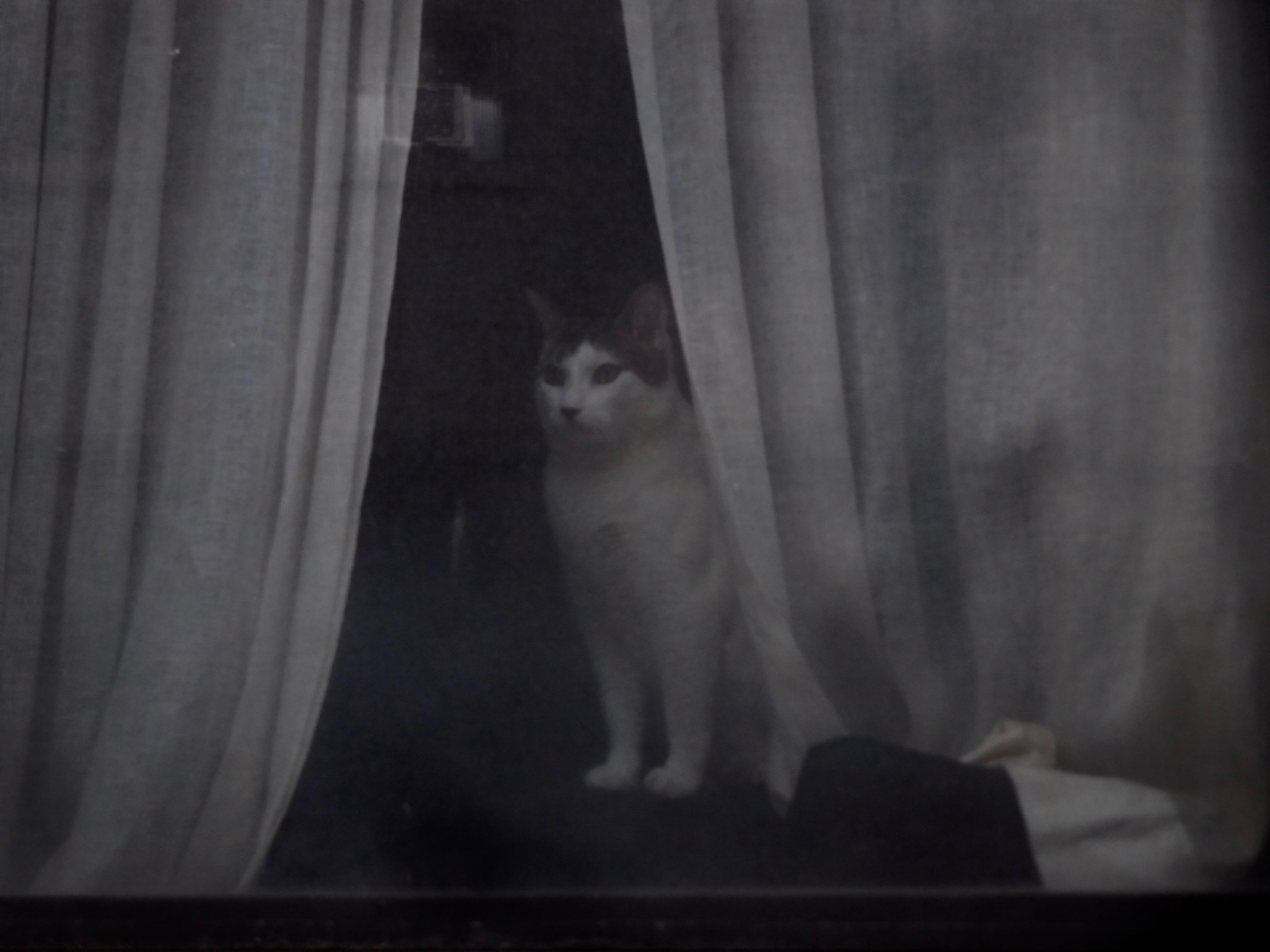
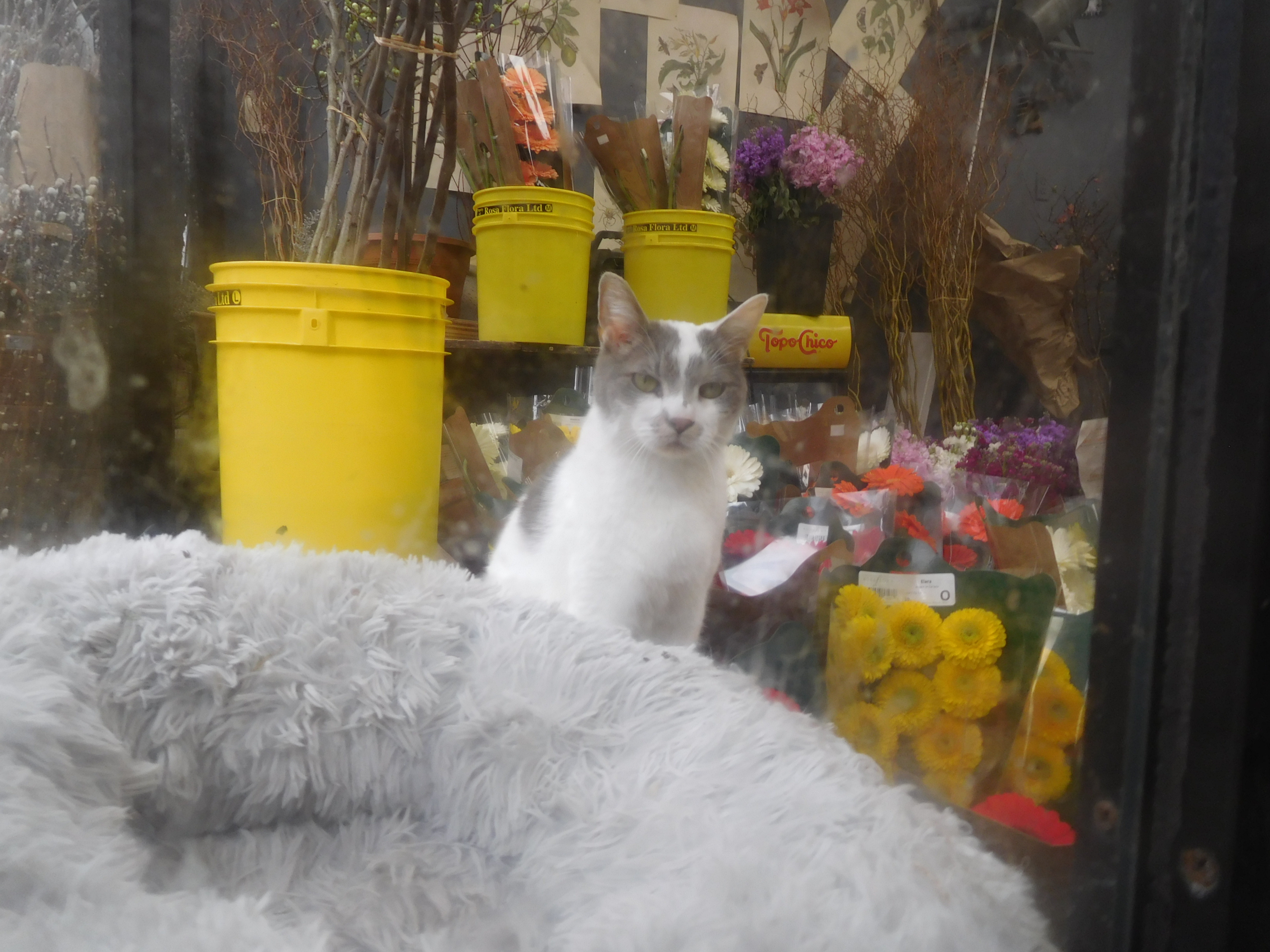
Across the street is the Piemonte Ravioli shop, with a friendly cat and good pasta that isn’t very expensive. What’s nice is that if the cat isn’t in sight, the lady will go and find him, and that’s what happened today. After I petted him I bought a bag of radiatori, the pasta shaped like little radiators, and as disappointed as I was about not getting a new gasket, the cat and the radiators went a long way to make my walk feel worth the effort.


May 1, 2012

THE WHEEL AND THE NYMPHS

Some months ago my downstairs neighbor Bertha died. We lived under the same roof for a very long time and I was sad to learn of her passing from another neighbor who told me that it makes him the oldest person in the building now. Bertha was as familiar as the fire escape and the banisters. I'd see her at the mailboxes or standing outside with her little shopping cart, and often we'd chat a little. One of those chats is in this old Walkers piece from 2006, so I'm putting it up in her honor. I will also post a new one very soon.
-RA

Last week I went to visit a friend staying in a hotel on 53rd Street between Lexington and 3rd Avenue. She told me the room cost $300 a night, which is now apparently average in price. Afterwards I walked over to 1st Avenue and down past the United Nations. At 42nd Street a huge demolition is going on. A gigantic building, which looks to be a formidable old power station, is being ferociously torn down and a banner on the fence around it announces new luxury residences coming soon.

I looked up into a big wound on the side facing me and I could see what appeared to be a giant iron wheel. I’m sure it was built to last forever. I took some pictures, but the whole thing was much too massive to fit into my camera.

Most of the buildings coming down around town try not to give up too easily. The buildings on 8th Avenue at 29th Street are being slowly chopped down by hand using sledgehammers, and the workmen can be seen carrying heavy wooden beams to the edge of the roof and dropping them over in clouds of brick dust. The old power station was really giving her guys a fight. The entire building is iron and steel and stone and brick. I asked a workman in a hard hat how the hell they were ever going to get that wheel down and he said, “With a big machine, hon.”

My tenement house sits on one of the last crummy old blocks of 7th Avenue while all around it big residences are shooting up. Lots of my neighbors have lived here forever. My neighbor Tito is one of those. Many years ago he worked in the factories over on the West Side which don’t operate any more. Bertha on the first floor remembers Tito then and said what a lovely young man he was, getting dressed up on Saturday night to go out and tango. She remembers when the apartments in my building rented for $16 a week in 1963. There are 16 apartments in the building, and all of them used to pay that $16 rent each week in cash to the super. The total sum for the whole building each week was $256. Well one day, said Bertha, the super absconded with the week’s fortune, never to be seen again. After that, the tenants had to pay with a check directly to the owner.

When spring finally comes to Chelsea, Tito brings out a lawn chair and a folding chair and keeps them down behind the garbage cans under the stairs. Then when he feels like it, he spends the day sitting or lying out on the corner of 7th Avenue and 22nd Street. Summer isn’t officially over until Tito’s folding chairs go back into his closet.

The building has gone through some changes while I’ve lived in it. There was a crack house in 1D for a year, when at all hours cadaverous and scurvy-looking people dragged themselves in and out, visiting the crack boss, a rotund, bearded person who looked like a Caribbean pirate. A few of the apartments were gutted and renovated to attract transient yuppies, but most are lived in by people who have been here a long time. Our super keeps his door open and cooks big dinners every night and anyone who feels like it can go right in. He’s decorated the area around the garbage with original, terrible artwork from various trashcans around the neighborhood, and other supers from other buildings come over in the evenings and watch his big TV.

On certain days the exterminator comes, and goes from floor to floor, banging on everyone’s door, yelling, “Exterminator! Exterminator!” He carries an old-fashioned looking copper can with a hose attached, from which he’ll come in and spray behind the stove and the radiator for roaches and lately, for bedbugs. The bedbugs are the newest fad. The building had a flyer by the garbage explaining that bedbugs, contrary to popular myth, don’t indicate poor hygiene and that they are moving into every kind of building in Manhattan, even the most luxurious hotels, thanks to DDT going out of commerce. They don’t carry diseases, but they bite and make life uncomfortable. They like to travel upwards, almost never down, and rarely but sometimes, across.

The D apartments in my building got bed bugs, and the lady next to me had to get a new mattress. I covered mine in plastic. I haven’t had an infestation, but three times I’ve found a nymph in the bathtub who managed to swim through from next door. Each time, I’ve killed the nymph and told the super and up comes the exterminator to spray around the bathtub. The exterminator told me that the worst cases he’s seen of bed bugs have been in new, rich buildings. The people call him SCREAMING, he said, and we laughed and laughed together while he sprayed in the hallway outside my door. With all the money they’ve paid, rich people expect to not have bugs in their apartments. There’s a theory that all the construction going on has somehow caused a renaissance of bedbugs. I read that once upon a time, only rich people got them, because only rich people had beds and linens and wooden cabinets for bugs to hide in and everyone else slept in straw.

When that big power plant on 42nd and 1st was built, every apartment in the city had bedbugs. And all the while, as bedbugs were being eradicated with DDT and eventually forgotten in New York, that huge iron wheel I saw was ceaselessly turning, around and around and around. Now the wheel has stopped, the workmen will have to get it down piece by piece so it doesn’t roll out onto the FDR Drive, and every second they’re doing that, a little nymph is making a nest in someone’s linen closet, waiting to grow up and bite.

March 26, 2006

WALKING HOME THE OTHER NIGHT

A few nights ago walking past Union Square on my way home I saw a big lug of a man sitting in a doorway holding a bag of frozen peas to his face. He looked to be about fifty, but the old kind of fifty. He looked like an old man who had been in a lot of rough places. His hair stuck out every which way, his coat was ratty; he had a big nose on his face and a big, grim-looking mouth. I saw him get up and lurch over to a delivery truck parked at the curb, take away the bag of peas and stand looking into the side-mirror. He looked as if he had walked out of a photograph from1970, with a punch in the eye from 1970. The bag of frozen peas made me think suddenly of my old friend Charlie, who would be past fifty himself now if he hadn’t died at 33. Charlie liked to use a bag of frozen peas for a headache. For a black eye he thought raw steak was good.

For a few years Charlie and I worked a coffee wagon together way downtown on Broad Street not far from the Exchange, and he was full of folk remedies and superstitions. He was forever crossing himself and knocking on wood and he wore a big gold crucifix around his neck. He grew up in East New York, Brooklyn, and all his male relatives looked like mafia. The women were tough as nails, too. He liked to tell a story about his mother, when she was a young woman, going out to Coney Island and getting stung by a dwarf with a shock wand. The dwarf would go around with an electrified wand and shock women as high up their skirts as he could get and they’d scream, but when he did it to Charlie’s mother, forget it. She turned around and punched the dwarf off his feet right there on the boardwalk in front of the whole damn carnival.

When I knew him, Charlie lived in Brooklyn on Church Avenue in a basement apartment with ten locks on the door. He liked to have people over for dinner and cook lasagna. I remember meeting his cousin Angela at one of those dinners, a very pretty, ebullient lady who was a New York City transit cop. She lived on Staten Island and had a very heavy accent. She never went anywhere without wearing her gun in its holster under her coat. At the dinner she made us all laugh by telling about the very first date she ever had with her husband, who was also a transit cop. He took her to Randazzo’s Clam Bar in Sheepshead Bay and she ordered the biggest plate of scungilli. Along with being nervous as hell, the scungilli gave her the worst case of gas she ever had. Sitting in his car by the water after dinner, it was all she could do to keep from breaking wind. “He was sayin’ all these romantic things, and I couldn’t even pay attention, I hadda concentrate, just to not let it out, right? Then he kissed me, and forget about it, it was like a tuba!”

Angela and her husband were trying to get pregnant without any luck, so she had decided to try a potion. She had passed by a shop that sold potions on East 9th Street in the East Village one day, but she felt nervous going in by herself. At the time I lived in that neighborhood, on East 11th Street between B and C, and she asked me if I’d go with her. I knew the place; it was a long, narrow old-fashioned shop called Enchantments. They had a big striped cat who wore a silver pentagram hanging from his collar and once in a while I used to go in and pet him and enjoy the particular atmosphere the place had.

I agreed to keep Angela company and I remember meeting her on the corner of 1st Avenue and 9th Street. She was wearing a mini skirt and stilettos, a leather jacket and her big Staten Island frosted hair. She said, “I’m SO happy you’re goin’ wit me, and can I just tell you? I know it’s gonna work. I just know it is.”

At the back of the shop was an alcove full of tinctures and a warlock. He was a young guy with a long beard and a lot of rings in his ears, and after Angela told him what her problem was, he prepared a potion in a medicine bottle, explaining the specific purpose of each tincture he added as it went in. Angela listened with a great show of respect. He gave her a little bag of salts and told her to put some into her bath each night and soak in it. I remember going up to the counter at the front so Angela could pay the cashier, a girl dressed in what looked like a Victorian mourning costume. Angela opened her coat to get at her billfold and her gun swung out. She set the potion on the counter, held up the bag of salts and said, “I just got one question about this, Hon. When I put this in the bath, is it gonna burn my vagina?”

I don’t remember what the clerk answered or what followed, but I do remember Charlie telling me later that the potion must have worked because Angela was finally pregnant. As far as I know, Enchantments still exists down on 9th Street, and by now, Angela’s baby would be all grown up.

Walking home I thought of another old mystical shop called the Magickal Childe on 19th Street. I remember the pressed-tin black ceiling, and buying a book of poems by Ira Cohen, Gerard Malanga and Angus MacLise from an intimidating old beard behind the counter. Somehow going into shops like that always felt like little adventures.


February 26th 2012

SOME LITTLE NOTES ABOUT VALI

Yesterday I read Clayton Patterson’s article in The Villager, in which he wrote about how Vali Myers used to come to New York every so often from her valley in Positano with a portfolio full of drawings to sell to ensure her livelihood for another year. Vali loved New York, and New York loved her, and whenever she came she always stayed at the Chelsea Hotel.

One of my very dear friends is Carole Ramer, whom Vali befriended back in the ‘60s while staying at the Chelsea. Carole was Abbie Hoffman’s right hand, Vali said, and she told me that when they first met, Carole looked like a gorgeous young black fox with her beautiful cascading black hair. Vali loved her as much for her charm as for her great loyalty to Abbie, and she never tired of listening to Carole’s accent, one of those old-fashioned New York badges of honor we don’t hear enough of anymore.

Vali introduced us and after I got to know her, Carole described meeting Vali for the first time in a little room at the Chelsea with Abbie. Vali was a beautiful, half-animal, half-woman creature who lifted her skirts and peed in the sink with complete grace, and Carole was dazzled.

Both Carole and I visited Vali in Positano in the 1990s, and after reading Clayton’s article I went looking in the notebooks I kept during some of those visits. These particular jottings are from December 1994, when Vali let me cram into her bed up the ladder in her tiny house, and just outside was Gianni Menichetti in his little tin-roofed palazzo full of cats, Gianni who first came to live in the valley in 1971 and still lives there today. I thought I’d post these for Carole in particular, but also for anyone else who might like them.


Vali climbing up the ladder to the bed saying, “Shit Piss and Corruption” and “Fuck a duck!”

She told me that at the beginning of this century there were bandits all over this coast. They probably slept right here in this valley, and the road down below was just a donkey path.

In the morning she said she had a dream in which she got sucked out of an airplane and was kind of zooming along in front of it hoping the pilot would see her.

Vali is annoyed because there is nowhere to put anything where the cats can’t get it. The butter and cheese must be hung from a hook or the black one especially will get it. She’s making coffee and saying, “I wish those bloody birds were laying, no such luck and I was dreaming of fresh eggs.” One of her bright ruffled skirts is drying on the line.

She told me about an Aboriginal girl in Australia called Donna who paints things, all kinds of things, like old chairs, and there’s someone who takes them to a gallery up in Sydney and people go nuts for them and buy them and then Donna buys all kinds of things for her mother.

Vali up on the bed saying that Sheba’s making stink all over the place and that Melville can really write when he gets going. She says James Joyce’s letters to Nora could put you off screwing forever.

She showed me the little courtesan drawing she’s working on; she put in the little house and the path out to Murat’s cave, and she showed me the place where she’ll draw in Fanny the donkey. And up above the path and the cliffs she drew in the Bay of Naples and sketched-out some doggies up near the volcano, and told me, “Some are sleeping and some are looking kind of like, ‘Look out, Mate, it’s going to blow!’”

Here she comes, through the gate with an armload of ferns for the pig like a gigantic salad. The late sunlight makes her hair blaze like a fire. This place is so beautiful, she’s saying, “You practically drop dead looking at it.”

It is almost black out. The radio is coming in clearly from Tunisia, and Gianni is cutting up potatoes. Here come Vali’s bare feet down the ladder as a muezzin calls out of the radio. Vali says she likes the long pauses. The radio from North Africa comes in so mysteriously, only at night. Arabic cat food ads. A sort of disco song is playing now and Gianni said it sounds like some kind of mechanical horse galloping. Vali’s telling Gianni not to cut the onions too fine or they come out tasting like petrol. She looked at a packet of sponges sitting there and read aloud, “SPUGNA ABRASIVA,” which she found hilariously funny.

The three of us sitting around the bowl of potatoes on a newspaper and afterwards I said, “Does anyone want a tangerine?” And Gianni sitting under the gas lamp, said, “But is it right to have fruit before the coffee?” To which Vali replied, “What do you think this is, Victorian England?”

She says koala bears sleep nineteen hours a day and that when they sleep they are probably thinking of gum leaves.

Outside Vali built a bower out of sticks and broom branches for Queenie the chicken and her little peeper. The roosters and chickens all crowded into the Elder branches. Today must be very close to the shortest day. The little dog Sardo has come creeping in to the house, as if we might chase him out, to sit next to the fireplace.

“Do you remember when you used to rub my bottom with butter?” Vali’s asking Gianni, and he’s saying,” Of course, and you would go off to sleep like an angel.”

The fire is down to embers, and Myers is climbing up the ladder to write in her book.

I hope reading these might inspire some memories for Carole too. And I wonder if like me, she found the little house in the valley not unlike Vali’s wonderful room in the Chelsea.

27 January 2012

Photos of Vali and Sheba up the ladder on the bed from that chilly December.

THE DANGERS OF THREAD

Dear Friends, I am putting up an old one today, at the suggestion of my friend Jeremiah Moss. I'm very sorry for how negligent I've been lately about posting new ones. I'm going to be much more diligent about it in the months to come. Meanwhile, this one was originally posted in 2007, but the perils of thread are no less perilous out there today. Sincerely, Romy

I was on the Crosstown bus reading the New York Post when an old geezer sat down next to me and said, “That’s my name,” pointing his finger at the front page. BOY WONDER, it said, with a picture of a skinny looking New York Yankee pitcher. I said, “Whaddaya know?” The old geezer said, “NOT whaddaya know! They called me the Boy Wonder!” He looked to be about 80 years old and he stank of cigarettes. He rooted around in a blue tote bag. “I met Einstein once,” he said. “Did he tell you anything worth knowing?” I asked him. “No, he didn’t,” he said. “But I know everything there is ta know.” He pulled several sheets of paper out of his bag. They were all covered in drawings of people’s faces, done in blue and red ballpoint pen. “Ya ever seen anything that good before? Ya ever seen anything in a museum that looked like this?" He showed me one all covered in geometric blue and red circles, each with a little face in the center. “I most certainly haven’t,” I said. He said to himself: “OK, next stop,” then he turned to me and said, “Ya know Marion Davies, the one that used to be William Randolph Hearst’s girlfriend? Well, I did all kinds of work for her when she lived in the apartment on 40th Street.”

“What kind of work?” I asked him, and he shrugged his shoulders as if he just couldn’t believe what a dingbat he’d saddled himself with. “Well, ART! I made all the art in her apartment! And look at this!” He pointed his finger down at one of his sneakers where there was a hole on the top. “I can see your little toe sticking out,” I told him. The bus swerved over to the curb and stopped. “I can’t AFFORD new shoes,” he said. “What artist can?” I said back, and he smiled at me before he descended the steps to the street. After he got off the bus, I wondered if he really had done work for Marion Davies and if she’d had an apartment on 40th Street. Maybe he had done all the art, or maybe the art was the colored paint on the walls of her dining room. I was inclined to believe that Boy Wonder had met Einstein and Marion Davies. Why not? Why make that up and not something else? I remembered meeting a man at a seder once who had been the greatest, most sought after wallpaper hanger in New York. He had hung wallpaper for some of the most fabulous people in the city. I think he even said he hung wallpaper for Barbra Streisand. It wasn’t something that just anyone could do. I got off the bus in front of the library on 23rd Street and went in to return a depressing video I had borrowed called Saraband. I knew it would be depressing when I checked it out because Ingmar Bergman made it, but I checked it out anyway. I wondered while I watched it if Liv Tyler was named after Liv Ullman.

Walking home, I saw a pigeon sitting on the edge of the curb on 7th Avenue and 22nd Street and I stopped to look. Another lady was looking at him too. The pigeon looked sad but alert, not at all like some of the old sick birds you see huddled in a doorway waiting to die. He didn’t look sick, but something was keeping him sitting there. I wondered if one of his wings was broken. The problem is that you won’t find a veterinarian in most neighborhoods who will help out a street pigeon or a rat. The lady took a little baggie of walnuts out of her bag and started dropping them in front of the bird, and he perked up. He leaped up and gobbled up the walnuts, and the lady put another little handful down in front of him. That’s when I saw that the bird’s two feet were shackled together with what looked like a piece of white thread. He could hop a little with his feet like that, and the more walnuts he swallowed, the more he hopped. But he couldn’t stand or walk normally, and after he ate up the nuts, he sank back onto the pavement.

Then a little man appeared. “Is it thread on his foot?” he asked in a thick Spanish accent. He had gray curly hair and was very effeminate. “Wait,” he said. “I catch.” He squatted down and carefully reached for the bird, but the bird flew in an arc and landed a few feet away. “I use coat,” the man said, taking off his jacket. From his pocket he drew a little pair of scissors and a pair of tweezers. “I cut thread,” he said. “Always I carry this for birds.” He said that the worst thing for pigeons is thread and hair extensions. He said that beauty salons throw out hair and the threads used for eyebrow threading. The birds get all caught up in them and their feet get bound together. He’d cut lots of birds loose from those threads. The lady had emptied out her walnut bag and the bird was fortified. He had no intention of being caught in the man’s jacket, and flew up to the roof of my building with the little thread between his feet. In all my years of looking at pigeons, I had never considered the dangers of thread and hair.

In the same day, I had met a man who made me realize how little I really know, and another one who told me that he knew everything there was to know. “Well, I do nothing this time,” the man said. He put his scissors and tweezers away. “I’m really not a bird person,” said the lady. “But I couldn’t just let him sit there.” Then we all went our separate ways without saying goodbye.

OLD CHELSEA STATION

In the post office last week I heard a lady talking to a man on the line behind me. They both looked to be in their seventies, and the lady was lamenting the fact that the post office had done away with the two big stamp machines that used to stand against the wall. “It’s very annoying to have to wait on such a long line just to buy one 44-cent stamp,” she said. The man told her that he had gotten a letter saying that this post office, Old Chelsea Station, would soon be closing, and the lady gasped. “I didn’t get that letter and I have a post office box here!” she said. “And this post office is on the National Register of Historic Places!” The man said he had read in the newspaper that a lot of post offices are closing all over the country. “People don’t use the post office like they used to,” he said. “And then there’s the lousy economy.” The lady said she didn’t think they could do away with the post office entirely because it is promised in the United States Constitution, and the man replied, “Well, that don’t mean much.”

I thought of the letter I got a couple of months ago telling me that a post office somewhere up near the Port Authority would be closing. I had wondered why I got the letter, since I have never been in that post office. A woman I know from the neighborhood told me recently that she got a letter saying Old Chelsea Station was closing, but without giving any details. I looked around for a sign saying something about it and didn’t see one, but I noticed the bears in their panel of wilderness over the doors facing 8th Avenue in the foyer. And like every time I’ve noticed them from the stamp line, I felt myself transported to some mountainous, misty place far away from the post office on West 18th Street.

Above the opposite entrance is another panel with three deer in it. I’ve always liked them and wondered about them, these handsome scenes that look to be made of metal. They’re almost colorless, and that, along with how high up they are, makes them very easy to miss. I stopped to look at them on my way out and noticed a signature at the bottom of each. I tried with and without my glasses, but could not read the name. So I came home and got my binoculars. When I looked at each of the panels through those, I could see all of their marvelous detail, just how hand-made they look, and I could read the signature, which is “P. Fiene.”

I went home to see what I could find out, and on the web site of the National Postal Museum I found this:

“Throughout the United States—on post office walls large and small—are scenes reflecting America's history and way of life. Post offices built in the 1930s during Roosevelt's New Deal were decorated with enduring images of the ‘American scene.’ In the 1930s, as America continued to struggle with the effects of the depression, the federal government searched for solutions to provide work for all Americans, including artists. During this time government-created agencies supported the arts in unprecedented ways. As Harry Hopkins, Roosevelt's relief administrator said in response to criticism of federal support for the arts, ‘(artists) have got to eat just like other people.’”

I read that the work for decorating post offices in the 1930s was not commissioned through the WPA, but through an office of the Treasury Department called the Section of Painting and Sculpture, and Paul Fiene was a sculptor who received one of the commissions. He had his studio upstate in Woodstock, New York, and the two panels, called “Deer” and “Bear,” are bas-relief cast stone covered in silver leaf, made in 1938 for Old Chelsea Station, which was built in 1935. I read that Paul Fiene had studied at the Beaux Arts Institute to Design here in New York, and that he won first prize in a life class in 1917. Then he won the Prix de Rome, which he had to decline because he didn’t have enough money to get to Rome to accept the prize, and I imagine that he must have been very disappointed. But he must have been very happy to get the commission to create two works of art to decorate this Manhattan post office. Imagining a post office built during the depression and decorated with money set aside for just that purpose having to close for lack of funds made me feel very sad.

Then I read that the Canal Street station, also on the National Register of Historic Places and built in 1937, has a beautiful relief of its own, by an artist named Wheeler Williams, called “Indian Bowman.” In reading about it, I saw that this Wheeler Williams made lots of beautiful things. He was once president of the Fine Arts Federation of New York and founder of the American Artist Professional League. He was also a supporter of the House Un-American Activities Committee and their search for communists. I don’t know why learning that surprised me, but it did.

Years ago I used to see Johnny Ramone in Old Chelsea Station all the time, in his holey jeans and leather jacket, opening up his P.O. box. Back then the notion of any post office closing would have been as hard for me to imagine as imagining Johnny Ramone as a conservative Republican, which, I just recently learned, he was.

The day before yesterday I went to the post office and asked a clerk if there was any truth to what was in the mysterious letters people were getting. “Well,” he said, “that depends.” I asked him what it would depend on, and he said, just as mysteriously as the letters: “It depends on what the post master decides to say.”


November 17, 2011

A PAGEANT OF OLD SCANDINAVIA

Today I pulled a book from the shelf to take with me in case there was a line at the post office. I chose A Pageant of Old Scandinavia, which once belonged to Vali Myers, in which she had written: ‘Vali, Chelsea Hotel, April 1’ on the title page.

Before I ever went to visit when she lived there, I remember hearing stories about the debauched scene going on in her room at the Chelsea every night with the crew of wild young Irish boys she had crammed in there with her. There was a story about a particular night when someone brought a pretty-looking young cop up from 23rd Street, got him drunk and then apparently they all played Russian Roulette with his service revolver and fired a bullet into the ceiling.

My friend Liza had introduced me to Vali, and during a quiet time while Vali was recovering from a brain seizure she’d had after one especially crazy night, Liza pestered me to go over and visit her by myself. She said I’d be glad I had later, and as usual, she was right. I finally forced myself to go over to the Chelsea and call Vali from the brown house phone in the lobby, and I will always remember hearing her warm and lovely voice say, “Come on up, Love.”

On the door to her room was a brass knocker in the shape of a fox’s head, and I used it to tap on the door. Her foxyknocker, she called it, and for some reason hearing Vali say ‘foxyknocker’ always struck me as funny. Her room felt like the inside of a gypsy wagon, so brightly painted it was in checkers the colors of an El Pico coffee can. One of the Irish boys was there, with long curly hair pulled back and tied with a rope. He stood at the stove making tea, and Vali patted a pillow beside her for me to come sit on. She said, “Hello, Love. This is Sheba,” and I petted her pretty dog. Vali’s eyes were blazing blue and when she smiled, her tongue came out and curled up at the end in a way that made it impossible for me not to laugh. And she laughed too. “Hello, Love,” she said again.

I gave her the little bouquet of flowers I had brought and she said, “Thank you, Love.” She said to the Irish boy, “Have we got a jar, Love?” A little TV was on next to Vali with the sound off, and she said, “I’ve been doing nothing but looking at the bloody TV.” A commercial came on for a cleaning product that showed a lady in a suburban-looking kitchen.” Vali said, “Wouldn’t you just die if you had to live in a place like that, Love?” I said I would, which was true, and she laughed and said, “Hello, Love.”

It was calm in Vali’s room. She opened a portfolio and showed me some of her drawings, the most beautiful, delicate, fine works of art I had ever seen. I can still picture so vividly her hands, tattooed like lace, as she turned over each one of the drawings, and all her pretty rings.

I went to visit a lot after that first time, in the late afternoons or early evenings, every few days, for the rest of the time she lived at the Chelsea. Often I had her all to myself, shared only with Sheba and the little pile of books she was currently reading, full of stars in their margins. She showed me her diaries, into which she pasted photographs and made drawings and wrote descriptions of everything she liked in the world. She copied her favorite poems into the diaries, and wrote lines such as, “It’s not a mustache, it’s a whisker.” One day she read me a story from A Pageant of Old Scandinavia called ‘Wolves or Seagulls?’ And she told me about a Dutch girl she had known once who looked like a seagull and wore dark glasses to bed.

When Vali eventually left the Chelsea to go back to Italy, Stanley Bard gave her a break on the back rent for a drawing, and Vali took Sheba the dog and went back to her wild mountain garden. I remember that on the day she left she was blue because someone had stolen her brass foxyknocker right off the door during the night. She gave me a few keepsakes, including A Pageant of Old Scandinavia, and invited me to come visit her in her wild valley, where she said every night was a starlight hotel.

When I opened the book in the Old Chelsea Station today, a letter fell out from Vali, written in her garden full of animals on the 26th of September 1997. While I waited on the line to buy stamps, I read part of it:

“It’s early morning here and I’ve just taken dear Fanny the Donkey outside of the garden so she can graze—the roosters are crowing and it’s still cool and fresh and I’ve just had my first coffee. Back here, it’s been a luxury to take care of the creatures again and make things beautiful around the place—the Pavilion and all I’ve painted Bombay Pink, I’ve cleaned out behind the house, so as one can see the waterfall again, and have managed to complete a new small painting called “Lamia” inspired by the beautiful little water snakes living by the stream and some lines from a poem of John Keats

‘so rainbow-sided, touch’d with miseries,

she seem’d, at once, some penanced lady elf,

some demon’s mistress, or the demon’s self.’

It’s not easy, Love, that world out there.”

And then I heard the clerk calling, “Step down!” and it was my turn to buy stamps. I felt very lucky to get the friendly lady instead of the one who always seems so put upon whenever she has to open the stamp drawer.

9 November 2011

I would like to dedicate this to one of the most wonderful of all New York ladies, Fedora Dorato. Rest in peace, Mrs. Dorato.